
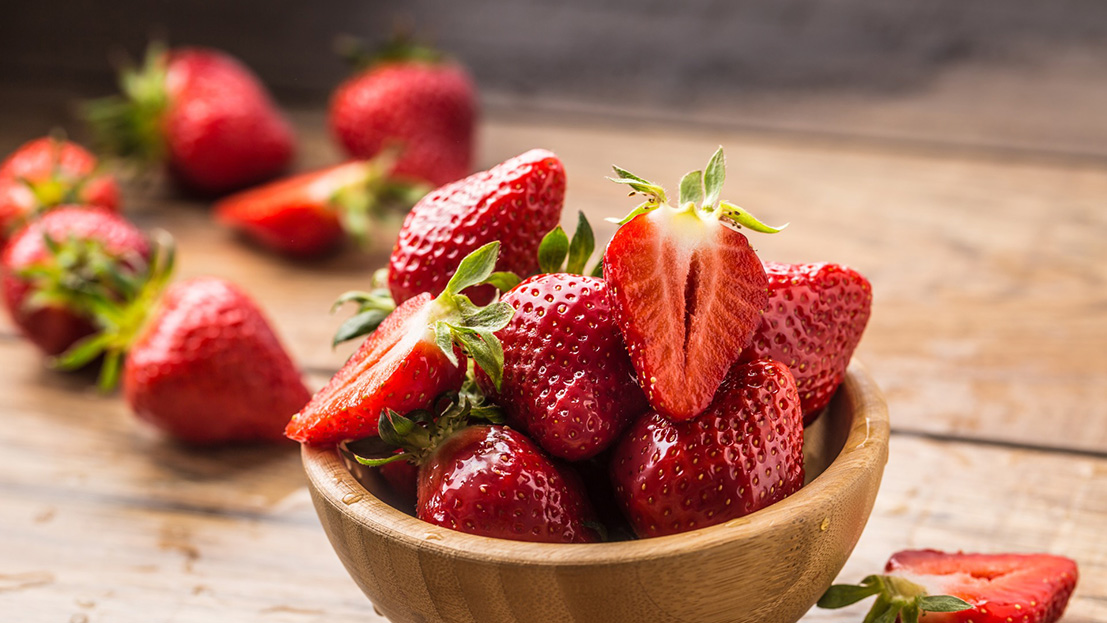
- Fun fact: Strawberries are one of the few fruits with seeds on the outside, with an average of 200 seeds on each berry.
- Strawberries belong to the Rosaceae botanical family which includes many edible fruits such as apples, pears, apricots, cherries, raspberries, almonds, etc.
Nutrition
Strawberries are naturally low in calories, an excellent source of vitamin C, and a good source of fiber.
- Vitamin C supports collagen and connective tissue formation along with immune function and wound feeling.
- Strawberries contain both soluble and insoluble fiber. Soluble fiber may assist in lowering cholesterol levels, while insoluble fiber promotes regularity and a healthy digestive system.
How to Purchase, Prepare, and Store
- Purchase strawberries at a local grocer’s, farmers market, pick your own farm, or roadside stand. In the Midwest, strawberries are typically in season during May and June, but they’re available year-round.
- Strawberries can be purchased fresh, frozen, dehydrated or freeze dried.
- Choose those that are firm to touch, bright red and free from bruises or mold. If green, the strawberries are not ripe and will have minimal flavor.
- Refrigerate unwashed in your crisper drawer and use them within 4 days. Wash prior to using.
- To freeze, wash and discard green stems. Pat dry with a paper towel and freeze in a single layer on a baking sheet; once frozen, place strawberries in a plastic freezer bag and use for smoothies or other desserts.
- Strawberries can also be made into jam or jelly and canned.
- Add fresh strawberries to grain or vegetable salads, salsa and smoothies or add to baked goods or other dessert recipes.
Nutrition Facts
1 cup whole fresh strawberries
- Calories: 54
- Protein: 0.96 g
- Fat: 0.33 g
- Carbohydrate: 11.9 g
- Fiber: 2.7 g
- Sugars: 7.29 g
- Calcium: 25.5 mg
- Magnesium: 19.5 mg
- Potassium: 242 mg
- Vitamin C: 89.4 mg
- Folate: 12 µg
- Vitamin A: 1.5 IU
- Vitamin K: 3.15 µg
Source: fdc.nal.usda.gov
Recipes
Request an Appointment
Success Stories

by mom Noreen I can never thank Allergy Associates of La Crosse and Dr. Mary Morris enough for the amazing lifestyle difference and peace you have brought my son, Nicholas, and my family. I recently came across a picture of Nicholas prior to sublingual immunotherapy treatment at Allergy Associates of La Crosse and was taken…
Read the rest of this story...